Profile

Cheryl Tay [4]
Koh Li Keng [10]
2.5B
14th Chapter.
PLMGSS, our roots.
Musicians; Piano-crazy.
Much In Love With Western Instruments.

Disclaimer

Two best friends, with same interests in music and many other ways.

Web Counter

Comments

Links

`&PLMGSS
`&Blogger
`&Blogskins


Archives

May 2009
July 2009

Sunday, May 17, 2009

What Is A Clarinet?

The clarinet is a musical instrument in the woodwind family. The name derives from adding the suffix -et meaning little to the Italian word clarino, meaning a particular type of trumpet, as the first clarinets had a strident tone similar to that of a trumpet. The instrument has an approximately cylindrical Bore (wind instruments), and uses a single reed.

Clarinets actually comprise a family of instruments of differing sizes and pitches. It is the largest such instrument family, with more than a dozen types. Of these many are rare or obsolete, and music written for them is usually played on one of the more common size instruments. The unmodified word clarinet usually refers to the B♭ soprano clarinet, by far the most common clarinet.

A person who plays the clarinet is called a clarinetist or clarinettist.

Some Pictures Of The Clarinet-
Bass Clarinet:
E-flat Clarinet:
Clarinet:
Close Up On Clarinet Buttons:

Sound It Produces:

How It Works:
The reed is attached to the mouthpiece by the ligature; and the top half-inch or so of this assembly is held in the player’s mouth.

The reed is on the underside of the mouthpiece, pressing against the player's bottom lip, while the top teeth normally contact the top of the mouthpiece (some players roll the upper lip under the top teeth to form what is called a ‘double-lip’ embouchure). Adjustments in the strength and configuration of the embouchure change the tone and intonation (tuning). It is not uncommon for clarinetists to employ methods to soften the pressure on both the upper teeth and inner lower lip by attaching pads to the top of the mouthpiece or putting (temporary) padding on the front lower teeth, commonly from folded paper.

Next is the short barrel; this part of the instrument may be extended in order to fine-tune the clarinet. As the pitch of the clarinet is fairly temperature sensitive some instruments have interchangeable barrels whose lengths vary slightly. Additional compensation for pitch variation and tuning can be made by increasing the length of the instrument by pulling out the barrel, particularly common in group playing in which clarinets are tuned to other instruments (such as in an orchestra). Some performers employ a plastic barrel with a thumbwheel that enables the barrel length to be altered. On basset horns and lower clarinets, the barrel is usually replaced by a curved metal neck.

The main body of most clarinets is divided into the upper joint, the holes and most keys of which are operated by the left hand, and the lower joint with holes and most keys operated by the right hand. (Some clarinets have a single joint. On some basset horns and larger clarinets the two joints are held together with a screw clamp and are usually not disassembled for storage.) The left thumb operates both a tone hole and the register key. Interestingly, on some models of clarinet, such as many Albert system clarinets, and increasingly some higher-end Boehm system clarinets, the register key is a 'wraparound' key, with the key on the back of the clarinet and the pad on the front. As well as the slightly exotic look this lends to the clarinet, advocates of the wraparound register key advocate improved sound, as well as the benefit that it is harder for condensation to accumulate in the tube beneath the pad.

The cluster of keys at the bottom of the upper joint (protruding slightly beyond the cork of the joint) are known as the trill keys and are operated by the right hand. These give the player alternative fingerings which make it easy to play ornaments and trills that would otherwise be awkward. The entire weight of the smaller clarinets is supported by the right thumb behind the lower joint on what is called the thumb-rest. Basset horns and larger clarinets are supported with a neck strap or a floor peg.

Finally, the flared end is known as the bell. Contrary to popular belief, the bell does not amplify the sound; rather, it improves the uniformity of the instrument's tone for the lowest notes in each register.

For the other notes the sound is produced almost entirely at the tone holes and the bell is irrelevant.

On basset horns and larger clarinets, the bell curves up and forward, and is usually made of metal.

Pitch range:

Clarinets have the largest pitch range of any common woodwind. The intricate key organization that makes this range possible can make playability of some passages awkward. The bottom of the clarinet’s written range is defined by the keywork on each particular instrument; standard keywork schemes allow a low E on the common B clarinet. The lowest concert pitch depends on the piece of music.

Nearly all soprano and piccolo clarinets have keywork enabling them to play the E below middle C as their lowest written note, though some B clarinets go down to E to enable them to match the range of the A clarinet. In the case of the B soprano clarinet, the concert pitch of the lowest note is D3, a whole tone lower than the written pitch. Most alto and bass clarinets have an additional key to allow a (written) E3. Modern professional-quality bass clarinets generally have additional keywork to written C3.

Defining the top end of a clarinet’s range is difficult, since many advanced players can produce notes well above the highest notes commonly found in method books. The G two octaves above G4 is usually the highest note clarinetists encounter. The C above that, is attainable by most advanced players and is shown on many fingering charts.

The range of a clarinet can be divided into three distinct registers. The lowest register, consisting of the notes up to the written B above middle C (B4), is known as the chalumeau register (named after the instrument that was the clarinet's immediate ancestor).

Qualities to look out for when purchasing:

The instrument must be clean, shiny and new-looking. The acoustics and the placing of all the parts of the clarinet all must be in position and firm.

Historical background:

The clarinet has its roots in the early single-reed instruments or hornpipes used in the Middle East and Europe.

The modern clarinet developed from a Baroque instrument. This instrument was similar to a recorder, but with a single-reed mouthpiece similar to that of the modern clarinet and a cylindrical bore. Lacking a register key, it was played mainly in its fundamental register, with a limited range of about one and a half octaves. It had eight finger holes, like a recorder, plus two keys for its two highest notes. At this time contrary to modern practice the reed was placed in contact with the upper lip.

Around the turn of the 18th century the chalumeau was modified by converting one of its keys into a register key to produce the first clarinet. This development is usually attributed to a German instrument maker named Johann Christoph Denner, though some have suggested his son Jacob Denner was the inventor. This instrument played well in the middle register with a loud, strident tone.

The original Denner clarinets had two keys, and could play a chromatic scale, but various makers added more keys to get improved notes, easier fingerings, and a slightly larger range. Clarinets were soon accepted into orchestras.

The next major development in the history of clarinet was the invention of the modern pad. Early clarinets covered the tone holes with felt pads. Because these leaked air, the number of pads had to be kept to a minimum, so the clarinet was severely restricted in what notes could be played with a good tone. In 1812, Iwan Müller, a Russian-born clarinetist and inventor, developed a new type of pad which was covered in leather or fish bladder. This was completely airtight, so the number of keys could be increased enormously. He designed a new type of clarinet with seven finger holes and thirteen keys. This allowed the clarinet to play in any key with near equal ease.

The final development in the modern design of the clarinet used in most of the world today was introduced by Hyacinthe Klosé in 1839. He devised a different arrangement of keys and finger holes which allow simpler fingering.

Music written for the clarinet:
Canto without words and dancing pieces - J. Dexters
Brahms clarinet sonata: a Cornerstone of the repertoire
Air and Simple Gifts - Anthony McGill

Some videos:


PokPok(: :: 5:47 AM

Saturday, May 16, 2009

Flute
The Flute is a musical instrument of the woodwind group. Unlike woodwind instruments with reeds, a flute is an aerophone or reedless wind instrument that produces its sound from the flow of air across an opening or embouchure.

Flutes are pitched in C. Generally the denser the material the instrument is made from the warmer and richer the sound it will produce. Some flutes come with an optional curved head which reduces the length of the flute to manageable proportions for young players.
A musician who plays the flute can be referred to as a flute player, a flautist, or a flutist.

Western concert flutes:


Indian bamboo flutes:

Japanese flutes:


History
Though the flute has been dated to prehistoric times, Theobald Boehm is mainly responsible for making flutes very similar to modern flutes known today. It has appeared in different forms and locations around the world. A three-holed flute, 18.7cm long, made from a mammoth tusk (from the Geißenklösterle cave, near Ulm, in the southern German Swabian Alb and dated to 30,000 to 37,000 years ago.) was discovered in 2004, and two flutes made from swan bones excavated a decade earlier (from the same cave in Germany, dated to circa 36,000 years ago) are among the oldest known musical instruments. A fragment of the femur of a juvenile cave bear, with two to four holes, found at Divje Babe in Slovenia and dated to about 2,017 years ago, may also be an early flute.

Some early flutes were made out of tibias (shin bones). The flute has also always been an essential part of Indian culture and mythology, and the cross flute believed by several accounts to originate in India as Indian literature from 1500 BCE has made vague references to the cross flute.

Playable 9000-year-old Gudi (literally, "bone flute"), made from the wing bones of red-crowned cranes, with five to eight holes each, were excavated from a tomb in Jiahu in the Central Chinese province of Henan.

The earliest extant transverse flute is a chi (篪) flute discovered in the Tomb of Marquis Yi of Zeng at the Suizhou site, Hubei province, China. It dates from 433 BC, of the later Zhou Dynasty. It is fashioned of lacquered bamboo with closed ends and has five stops that are at the flute's side instead of the top. Chi flutes are mentioned in Shi Jing, compiled and edited by Confucius.


How it works
I expect that most of us have played a note by blowing over the top of a bottle. The air in the bottle is springy and can vibrate, rather like a spring with a mass on it. When you blow across the top of the bottle, the stream of air from your lips can be deflected up or down by the expanding and contracting air in the bottle. When the stream is deflected down, some of it goes into the bottle, increasing the vibration. Thus the power in the stream of air can sustain the vibration in the bottle.
The mouthpiece of the flute (diagram below) works on the same principle - a jet of air passes a volume of air (the air in the tube of the instrument) which can vibrate.

When the flautist plays the flute, they blow a thin stream of air flat across a hole. When the air reaches the other side of the hole, it hits the hole’s sharp metal edge. The next part is the weird part. Instead of the air spliting into two streams, one above and one below the metal, it alternates. In other words, it goes back and forth between going above the metal and below the metal. The part that goes below the metal goes into the flute, causing the air in the flute to oscillate. The air oscillates along the length of the flute, and the locations of open holes changes its oscillation, changing the notes produced.

Notes Range
The European flute has a range from a low C (middle C on a piano) to a high E flat. The entire range is a little more than 3 octaves. There are also some European flutes with extra keys that allow the flautist (the flute player) to go as far down as a B or as far up as an F. However, these extreme notes are very difficult to play and there aren’t very many pieces that require anything above a high C.


The sound it produces
A flute produces sound when a stream of air directed across a hole in the instrument creates a vibration of air at the hole.

The air stream across this hole creates a Bernoulli, or siphon, effect leading to a von Karman vortex street. This excites the air contained in the usually cylindrical resonant cavity within the flute. The player changes the pitch of the sound produced by opening and closing holes in the body of the instrument, thus changing the effective length of the resonator and its corresponding resonant frequency. By varying the air pressure, a flute player can also change the pitch of a note by causing the air in the flute to resonate at a harmonic other than the fundamental frequency without opening or closing any holes.

To be louder, a flute must use a larger resonator, a larger air stream, or increased air stream velocity. A flute's volume can generally be increased by making its resonator and tone holes larger. This is why a police whistle, a form of flute, is very wide for its pitch, and why a pipe organ can be far louder than a concert flute: a large organ pipe can contain several cubic feet of air, and its tone hole may be several inches wide, while a concert flute's air stream measures a fraction of an inch across.

The air stream must be directed at the correct angle and velocity, or else the air in the flute will not vibrate. In fippled or ducted flutes, a precisely formed and placed windway will compress and channel the air to the labium ramp edge across the open window. In the pipe organ, this air is supplied by a regulated blower.

Qualities to look out for when buying one
First, you should be able to play easily and with a good sound all the way down to low C without pressing hard on the keys. The lowest octave of the flute is where any leaks or adjustment problems are most easily detected. If you press harder on the keys and the flute sounds better, then there are leaks or adjustments which need to be corrected. (Leaks are usually caused by air leaking out of the flute between the pads and the tone holes, although poor adjustments can cause sound production problems too.) (and leaking tone holes) (and holes or fraying in the pads)
Other things to look for: do the three parts of the flute fit together smoothly and evenly at the tenons, without binding or being too loose? Is the cork in the headjoint sealing properly so no air leaks out? Is the spring tension even from key to key? If the springs are too stiff, the keys will be hard to press; if the springs are too loose, the keys will go down easily but they will not snap back properly, making it necessary to lift your fingers off the keys. This can result in hand problems. Is there any side to side motion in the keys? Is there any lost motion? Are all the adjustments correct? Do the pads seat properly? Are the key heights correct? How much wear and tear is on the pads?

music written for flute


This is the "Bouree" written by Bach.
This is played as flute solo.


This is played as an ensemble, named,
"P.sarasate Zigeunerweisen Op.20".

CHICKEN ANIMATION :: 8:42 AM

What Is A Cello:
The violoncello, or commonly known as cello, is a bowed string instrument. A person who plays a cello is called a cellist. The cello is used as a solo instrument, in chamber music, and as a member of the string section of an orchestra. It is the second physically largest member of the Violin family of musical instruments, next to the Double Bass.

Some Pictures Of The Cello-
Cello With Bow:
Unique Electric Cello:
Cello [Commonly seen] :
The Sound It Produces:
The sound of which it makes is very similar to the violin, except that the cello has a lower range of notes. It is played by different types of methods, bowing, pizzicato, glissando (effect played by sliding the finger up or down the fingerboard without releasing the string. This causes the pitch to rise and fall smoothly, without separate, discernible steps) , harmonics (Natural harmonics are produced by lightly touching (but not depressing) the string with the finger at certain places, and then bowing the string) , staccato, legato, and many other more types.

How It Works:
The cello is usually played while seated. Its weight is supported mainly by its or spike, which rests on the floor. Sometimes, an endpin support is needed to prevent the endpin from slipping on smooth surfaces. The cello is steadied on the lower bout between the knees of the seated player, and on the upper bout against the upper chest. The neck of the cello is above the player's left shoulder, and the C-String tuning peg is just behind the left ear. The bow is drawn horizontally across the strings.
The position of the left hand fingers along the strings determine the pitch of the note. The closer to the bridge that the string is depressed, the higher in pitch will be the resulting sound, because the vibrating string length has been shortened.
Vibrato is a small oscillation in the pitch of a note, usually considered expressive. It is created by a partial rotation of the upper arm at the shoulder, which translates into a linear oscillation of the lower arm. The fixed point of contact of the fingertip on the string absorbs this motion by rocking back and forth. It is this change in the attitude of the fingertip to the string which causes the pitch to vary.

Pitch Range:
From C two octaves below middle C to E an octave above middle C.

[cello keyboard]


Qualities to look out for when buying instrument:

Standard-sized cellos are referred to as "full-size". However, cellos come in smaller (fractional) sizes, from "7/8" and "3/4" down to "1/16" sized cellos (e.g. 7/8, 3/4, 1/2, 1/4, 1/8, 1/10, 1/16). The smaller-sized cellos are identical to standard cellos in construction, range, and usage, but are simply 'scaled-down' for the benefit of children and shorter adults. A "half-size" cello is not actually half the size of a "full-size", but only slightly smaller. Many smaller cellists prefer to play a "7/8" cello as the hand stretches in the lower positions are less demanding.
Approximate dimensions for 4/4 size cello Average size (cm) Average size (in)
Approximate width horizontally from A peg to C peg ends 16 6 - 5/16
Back length excluding half round where neck joins 75.5 29 - 3/4
Upper bouts (shoulders) 34 13 - 3/8
Lower bouts (hips) 44 17 - 3/8
Bridge height 9 3 - 9/16
Rib depth at shoulders including edges of front and back 12.5 4 - 15/16
Rib depth at hips including edges 12.8 5 - 1/16
Distance beneath fingerboard to surface of belly at neck join 2.2 7/8
Bridge to back total depth 26.7 10 - 1/2
Overall height excluding end pin 121 47 - 10/16
End pin unit and spike 5.5 2 - 5/8

Historical Background:


By 1529 a 3-stringed instrument was made, probably in Italy. About a century later it was called "violincello", which is Italian for "small double bass". That is what we get the word "cello" from. Late in the 1600’s, composers began writing music for the cello. It played the bass in the early days of the string quartet, only occasionally taking the melody. It became distinct in symphony orchestras and in chamber music in the 1700’s and 1800’s. The cello was used for many years to strengthen the bass section of church choirs.

The cello is the second largest of the string section. It is the tenor or baritone of the string family. The notes have a deep, warm tone. Of all the strings, the rich, singing sound of the cello make it sound the most like a human voice. Some people believe it is the most expressive instrument in the orchestra. In string quartets the cello usually plays the lowest notes.

The cello is played with a bow or plucked (pizzicato). It is about 4 feet tall, approximately 1-1/2 feet across, and weighs 22 pounds. The thicker and longer strings of the cello make it a whole octave deeper than the viola.

Music Written For It:
William Tell Overture by Tchaikovsky
Cello solos from Piano Concerto No. 2 by Brahms
Symphony No. 3 the third movement by Brahms
Carnival of the Animals "The Swan" by Saint-Saens
Cello Concerto in D by Haydn
Cello Concerto in B minor by Antonin Dvorak
Cello Concerto no. 1 in C major by Joseph Haydn
Variations on a Rococo Theme for Cello and Orchestra by Peter Tchaikovsky
Brandenburg Concerto by J.S. Bach
Sonata for Cello and Piano by Claude Debussy
La Mer (The Sea)(first movement) by Claude Debussy
Don Quixote (the cello actually plays the mixed-up man of La Mancha) by Richard Strauss
Gloria in D 1st movement by Vivaldi - This has a chorus singing too.


PokPok(: :: 8:01 AM

Friday, May 15, 2009

What Is A Harp?
Is it the instrument played by angels floating on clouds? Or is it that tall, golden, half-hidden thing in the symphony orchestra?
The harp, in fact, is all those things. Depending on its size (which varies considerably), a harp may be played while held in the lap or while stood on the floor. Harp strings can be made of nylon (sometimes wound around copper), gut(more commonly used than nylon), wire, or silk. A person who plays the harp is called a harpist or a harper. But the term, harpist, is more common in modern times while the term harper is used in ancient times.

Some Pictures Of the Different Types Of Harps-
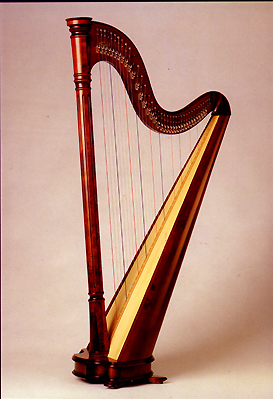
Big Pedal Harp:
Birch Harp:
Lever Harp:

Close Up Of Levers On Lever Harp:

Lever Lap Harp:
Comparison of Lever Harp And Pedal Harp:
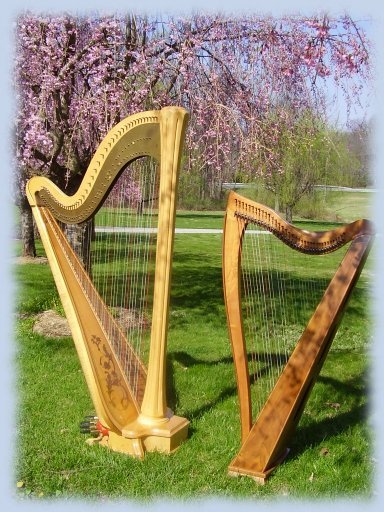
(Lever on the right and Pedal on the left)

The Sound It Produces:
The sound the harp produces is very special, as that type of sound is never heard in any other instrument, no matter if its woodwind, string, brass or percussion. Unlike the violin and the viola which sounds similar, the harp sounds beautiful the moment you hear it, but not the violin and the viola, as you have to master the skill of not making that squeaky sound whenever it is played and it would take a long time to master that. But no matter how you pluck it, be it upwards, downwards, toward the soundboard or any other way, it sounds heavenly and soothing.

How It Works:
Most European harps have a single row of strings with strings for each note of the C Major scale (over several octaves). Harpists can tell which strings they are playing because all F strings are black or blue and all C strings are red or orange. The instrument rests between the knees of the harpist and along their right shoulder.
The first four fingers of each hand are used to pluck the strings; the little fingers are too short and cannot reach the correct position without distorting the position of the other fingers, although on some folk harps with light tension, closely spaced strings, they may occasionally be used. Also, the little finger is not strong enough to pluck a string. Plucking with varying degrees of force creates dynamics. Depending on finger position, different tones can be produced: a fleshy pluck (near the middle of the first finger joint) will make a warm tone, while a pluck near the end of the finger will make a loud, bright sound.

Pitch Range:
(Modern pedal Harp)
The number of strings and the number of octaves present are dependent on the type of harp and the price paid for it.

Qualities To Look Out For When Buying:
The harp has to be in good condition with all the strings and levers or pedals in perfect condition. With just one small mistake in stringing the harp, the string would come loose and affect the playing of the songs due to the gap in between. A good but expensive harp would cost about 4 to 6 thousand Singapore dollars but some would even cost up to 30 thousand Singapore dollars and more, if the harpist is willing to pay for it. But some lousy but cheap harps can also cost only 600 Singapore dollars to 1 thousand Singapore dollars. It is also quite rare to find a good, cheap and new harp. Those kind of harps are usually 2nd hand and are sold to 2nd-hand musical instrument shops at a price of 1 to 3 thousand Singapore dollars.

Historical background:

Angle harps and bow harps continue to be used up to the present day. In Europe however a further development took place: adding a third structural member, the pillar, to support the far ends of the arch and sound box.

European harps in Medieval and Renaissance times usually had a bray pin fitted to make a buzzing sound when a string was plucked. By the baroque period in Italy and Spain more strings were added to allow for chromatic notes; these were usually in a second line of strings. At the same time single-row diatonic harps continued to be played.

In Germany in the second half of the 17th century, diatonic single-row harps were fitted with manually-turned hooks which fretted individual strings to raise their pitch by a half step. In the 1700s, a link mechanism was developed connecting these hooks with pedals, leading to the invention of the single-action pedal harp. Later, a second row of hooks was installed along the neck to allow for the double-action pedal harp, capable of raising the pitch of a string by either one or two half steps. The idea was even extended to triple-action harps but these were never common. The double-action pedal harp remains the normal form of the instrument in the Western classical orchestra.


Music Written For The Harp:

The music written for piano and for other instruments that have the pitch range of similar to the harp is also possible for playing on the harp. Songs can be played solo or in an ensemble, simple or complex. A more difficult piece of music is also easier to play in a ensemble as the notes of chords can be easily split so the burden would not be so much and the key and accidentals are also easy to change using levers of pedals, depending on the harp.

Some Videos On The Harp And Some Pieces Played On Them:


Bibliography:

http://en.wikipedia.org/wiki/Harp

http://www.harpspectrum.org/what/what.shtml

http://www.google.com.sg

http://www.youtube.com/watch?v=u8Ww-Iwa6iY


PokPok(: :: 11:00 PM

Electric Guitar


Classical Guitar


Acoustic Guitar


The guitar is a musical instrument with ancient roots that is used in a wide variety of musical styles. It typically has six strings, but four, seven, eight, ten, eleven, twelve, thirteen and eighteen string guitars also exist.

Guitars are recognized as one of the primary instruments in flamenco, jazz, blues, country, mariachi, rock music, and many forms of pop. They can also be a solo classical instrument. Guitars may be played acoustically, where the tone is produced by vibration of the strings and modulated by the hollow body, or they may rely on an amplifier that can electronically manipulate tone. Such electric guitars were introduced in the 1930s and continue to have a profound influence on popular culture.

Notes Range


History
Before the development of the electric guitar and the use of synthetic materials, a guitar was defined as being an instrument having "a long, fretted neck, flat wooden soundboard, ribs, and a flat back, most often with incurved sides". Instruments similar to the guitar have been popular for at least 4,000 years.

While today's classical guitar first appeared in Spain, it was itself a product of the long and complex history that saw a number of related guitar types developed and used across Europe. The roots of the guitar can be traced back thousands of years to an Indo-European origin in instruments, then known in central Asia and India. For this reason the guitar itself is distantly related to instruments such as the tanbur and setar, and the Indian sitar. The oldest known iconographic representation of an instrument displaying all the essential features of a guitar being played is a 3,300 year old stone carving of a Hittite bard. The modern word, guitar, was adopted into English from Spanish guitarra (German Gitarre, French Guitare), loaned from the medieval Andalusian Arabic qitara, itself derived from the Latin cithara, which in turn came from the earlier Greek word kithara, a possible descendant of Old Persian sihtar.

The sound it produces
The guitar is a transposing instrument. Its pitch sounds one octave lower than it is notated on a score.

In all types of guitars the sound is produced by the vibration of the strings. However, because the strings can only displace a small amount of air, the volume of the sound needs to be increased in order to be heard. In an acoustic guitar, this is accomplished by using a soundboard and a resonant cavity, the sound box. The body of the guitar is hollow. The vibrating strings drive the soundboard through the bridge, making it vibrate. The soundboard has a larger surface area and thus displaces a larger volume of air, producing a much louder sound than the strings alone.


How it works
Guitars can be constructed to meet the demands of both left and right-handed players. Traditionally the dominant hand is assigned the task of plucking or strumming the strings. For the majority of people this entails using the right hand. This is because musical expression (dynamics, tonal expression and colour etc) is largely determined by the plucking hand, while the fretting hand is assigned the lesser mechanical task of depressing and gripping the strings. This is similar to the convention of the violin family of instruments where the right hand controls the bow. A minority, however, believe that left-handed people should learn to play guitars strung in the manner used by right-handed people, simply to standardise the instrument.

Qualities to look out for when buying one
Depends a lot on what type of music you want to play.
Some necks are thinner and some are longer with more access to the frets all the way up and down. Some electrics have a hollow body, and some have solid wood bodies. If you like a good solid feel and don't mind a little extra weight on the guitar, try a Gibson LesPaul studio. You can also get a very good price and good looks with an epiphone brand name, I beleive is made by Gibson. All in all, the qualities that make one guitar better than an other are mostly personal taste.

The kind of things you should be looking for in a guitar are the length and width of the neck (the neck is the part where the strings are) if you are looking to play lead guitar its best to get an electric guitar with a long neck that has a thin width, if you are looking to buy an electric make sure it has good pick up (good pick up can also be ensured with a good amplifier), make sure the sound is clear and every string can be heard when its strum, make sure it's a good brand; Gibsons, Fenders, Ibanez' are good brands there are lots out there so make sure you look around before you make any choices, like i said a good amplifier makes the guitar sound 100 hundred times better so make sure you get a good one if you are buying an electric guitar.

Music written for guitar


This is an example of a guitar ensemble of a written music:
"Mountains in Autumn" , this is played in an ensemble.


This is a written music, "Canon in D".
This is played as solo guitar.
JingJing

CHICKEN ANIMATION :: 6:59 AM

Get awesome blog templates like this one from BlogSkins.comGet awesome blog templates like this one from BlogSkins.com